
by Brittany Reese
The final gathering of the Arkansas Collegiate Civic Leadership Academy (ACCLA) brought students to the Winthrop Rockefeller Institute for a moment that was equal parts celebration and call to action as they completed the statewide program. ACCLA was founded through the generous support of the McKuin Fund, the Engaged Learning Network, and AT&T Arkansas.
As 30 students from nine colleges and universities concluded the academy, speakers emphasized a shared message: Civic leadership does not begin after graduation — it begins now.


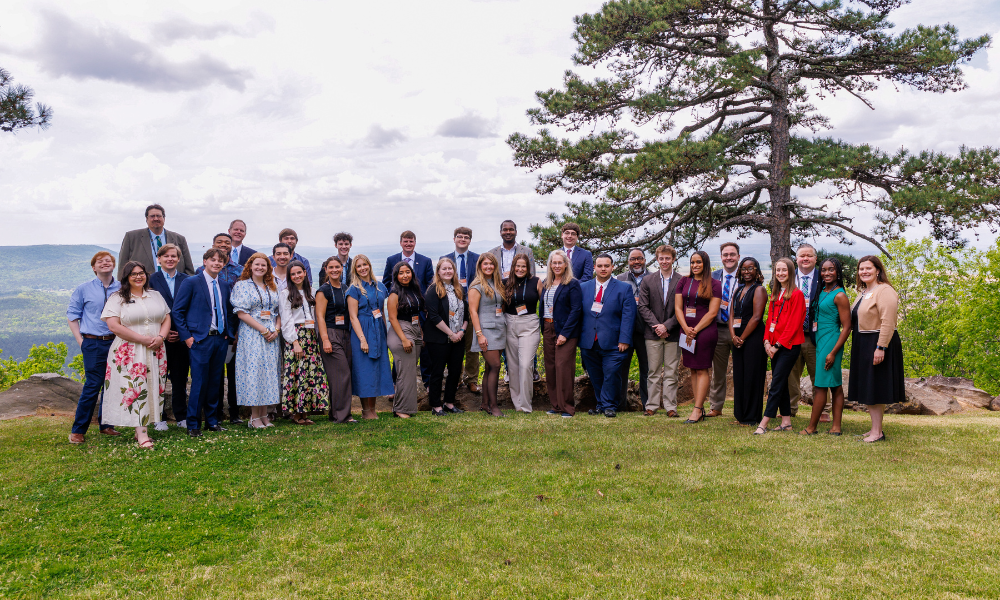
Welcoming the cohort back to the Institute, Institute Executive Director/CEO Janet Harris said ACCLA was created in response to conversations with young Arkansans who questioned whether they were prepared to engage in civic life and whether their voices mattered.
“Even though the journey that we have taken together in this specific program is ending, your career as a civic leader and your time and journey as a civic leader are just beginning.”
Janet Harris
Class of 2026
- Cian Devers
- Natalie Dunman
- Ayden George
- Emily Hill
- Taylor McIntyre
- Joseline Munoz
- Levi Seward
- George Vaughn
- Jasper Millsaps
- Johanna Pena Vasquez
- Gabriel Strickland
- Cole Mandrell
- Lynn Enzor
- Trinity Foster
- Paige Gross
- John Grady Harper
- Phoebe Harris
- Mia Hastings
- Luis Maya
- Abby Shoemaker
- Kathryn Tandy
- Braden Carr
- Axton Tackett
- Brianna Butler
- Aareyon Wallace
- Kylie McGraw
- Kaleb Jacobs
- Vanessa Martinez
- Isabel Shelton
- Taylor Yates
Redefining Public Service


Among the featured speakers was retired Lt. Gen. Dr. Jay B. Silveria, president of the University of Arkansas System, who encouraged students to broaden their understanding of public service. Drawing on decades of military and academic leadership, Silveria said service can take many forms.
“There are countless ways that you can serve your people,” Silveria said. “No matter what you pursue and no matter what you do, I believe we all have a responsibility to serve.”
Civic engagement, he added, is defined not by title but by commitment.
The Moment Leadership Becomes Personal

A central idea threaded throughout the session was a simple but powerful shift in perspective of they.
Silveria urged students to notice when they catch themselves saying “they” should do something. Leadership, he explained, begins when that responsibility becomes personal.
“The element of leadership is the moment that you realize that you’re ‘they.’”
That realization doesn’t always come immediately, but when it does, leadership is no longer theoretical. It’s actionable.
Alignment is the Leader’s Constant Work


To illustrate the challenge of leadership, Silveria shared a story about a submarine cook who understood how everyday work supported a larger mission. Helping people see how individual roles connect to shared purpose, he said, is a constant responsibility for leaders.
“If you’re in a leadership role, you will do nothing but try to seek alignment in an organization,” Silveria said. “And it is very, very difficult.”
During a question-and-answer session, students asked about collaboration, generational apathy, and institutional resistance. Silveria said students can drive momentum for change.
“When faculty resist, and staff resist, and leadership resists,” he said, “students can drive that connection.”
Silveria closed by underscoring the purpose behind leadership.
“The reason that I do what I do is you.”
A Conversation with State Senator Jamie Scott


Arkansas Senator Jamie Scott of District 12 reinforced that public service begins with courage, not certainty. Speaking with students, Sen. Scott reflected on her path to elected office and encouraged them to pursue opportunity even when outcomes are uncertain.
“Don’t be afraid to take opportunities where you might be in the super minority,” she said. “You never know where those opportunities can lead.”
She emphasized the importance of mentorship, humility, and persistence.
“Ask for mentors,” Sen. Scott insisted. “Don’t be afraid to ask and don’t take it personally when somebody doesn’t have the capacity.”
Sen. Scott said effective leadership depends on relationships and bipartisan cooperation, emphasizing how much of her own work has been accomplished through bipartisan legislation.
She closed by urging students to focus on service before seeking titles, emphasizing preparation, integrity, and hard work.
“Hope Is in This Room”


In his graduation address, Dr. John C. Davis, executive director of the David and Barbara Pryor Center for Arkansas Oral and Visual History and political science professor at the University of Arkansas, reflected on the statewide cohort that brought together students. Davis framed the moment as both personal and national.
“You’re here in this room, at this time, at this place, for a purpose,” he said, adding that despite division, “there’s always hope,” and “hope is in this room.”
The work ahead, he stressed, begins locally because “the change has to come from the bottom up,” through “grassroots, nonpartisan” service.
His charge to students was clear and lasting: Never feel like you don’t belong in the room. Quoting John Wesley, Davis urged them to “do all the good you can,” now and in the communities they will serve next.
Class of 2027 Application
Student applications will open on April 24, 2026. Check back here to apply!
Applications for the Arkansas Collegiate Civic Leadership Academy Class of 2027 open on April 24, 2026! College students from across Arkansas are invited to deepen their civic leadership skills and engage in meaningful dialogue about the challenges facing their communities and state.