Barry McKuin, who has given 15 years of service to the Winthrop Rockefeller Institute as a board member and advocate for the nonprofit organization, participated in his last board of directors meeting on June 24. A luncheon was held in his honor, and he was presented with a chair engraved with his name on the back, along with “All Good Wishes” — Winthrop Rockefeller’s favorite closing for letters.
“Winthrop Rockefeller said, ‘It is not enough to contribute money. People must make the gift of themselves, of their own time, their creative talent and their spiritual strength,’” Institute Executive Director Dr. Marta Loyd said during the luncheon. “Winthrop never knew Barry, but it certainly sounds like he is just the kind of person Winthrop would want to know, and the kind of person he would appreciate thinking about how best to carry his legacy forward.”
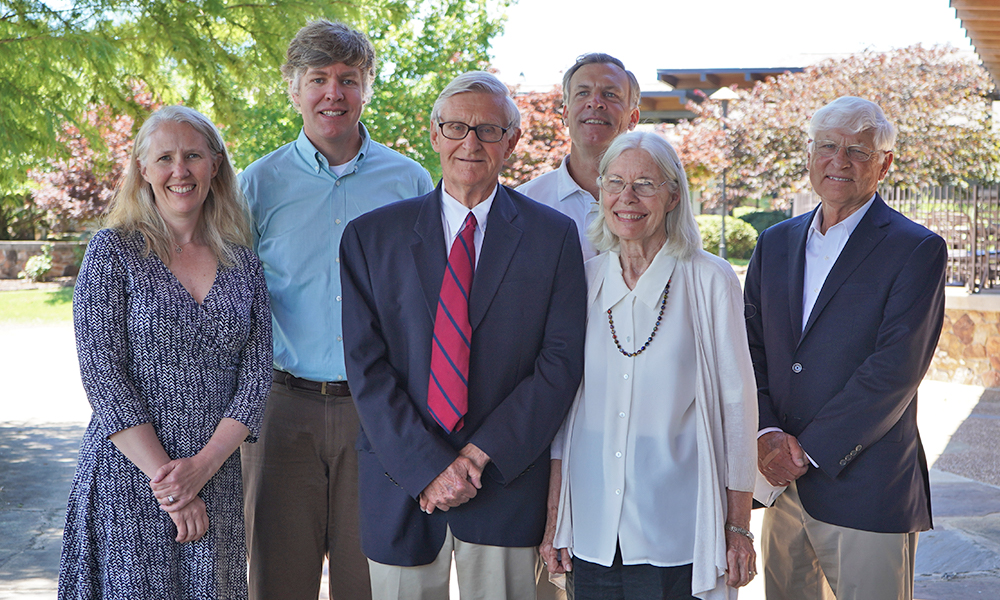
McKuin has a long history with not just the Institute, but the 188 acres of pastoral mountaintop it sits upon. After Winthrop passed away in 1973, his estate took over Winrock Farms and later hired McKuin as its first Chief Financial Officer. He retired after several years of work, both with Winrock Farms and with Winthrop Paul, Winthrop’s son and former Lt. Governor of Arkansas. He was also heavily involved with the Conway County Economic Development Corporation (CCEDC) during this time, eventually becoming president.
There came a day, according to McKuin, when he received a call from Allen Gordon, a lawyer in Morrilton. Gordon said there was “a little group trying to get together on the mountain,” and wanted McKuin to sit in on the beginning conversations. Though unofficial, McKuin continued to participate in the following meetings until a task force formed what is now the Winthrop Rockefeller Institute, and he was invited to be on the original board of directors. Over the next few years, the Institute’s facilities were improved and expanded, yet its core mission was difficult to define or be put into action.
“I stayed on that board because I live here, I have an association with this place, and I thought it could be turned into something extremely good for Morrilton, Arkansas, and the Rockefeller name,” McKuin said.
“Barry never lost sight of what it could mean to Arkansas,” Lisenne Rockefeller, secretary of the Institute’s board of directors, said. “His agenda was the Institute’s. Deeply ethical and moral, he encourages the best in everyone and he does it by modeling those characteristics. He never gave up on his vision for the Institute and as a result, the Winthrop Rockefeller Institute is on a solid foundation for the future.”
Once the Institute’s mission became clear, its endeavors were always supported by McKuin’s leadership. One program, Uncommon Communities, exists largely due to McKuin introducing Institute administrators to Dr. Vaughn Grisham, a now-retired professor from the University of Mississippi. McKuin remembers hearing a lecture by Dr. Grisham when he was still working for Winrock Farms. He became so enamored with Grisham’s message of community development preceding economic development, that he, admittedly someone who does not take notes, began scribbling them onto the back of an event flyer. Dr. Grisham spoke to the CCEDC several times at McKuin’s request, and helped form Uncommon Communities, which Conway County was an inaugural participant of. McKuin and his wife, Phyllis, attended every single session.
“Incredibly intelligent, Barry is one of those people who can see the big picture, focus on the future, and keep others on track,” Rockefeller said. “His commitment to his family and community is a blessing to all.”
Asked what he thinks of the Institute today, McKuin said, simply, “I’m pleased. I’m extremely pleased. Things are beginning to blossom as they should.”
Responses